Running from Illness

It takes a very particular sort of person to care for sick children—someone with the patience of a saint, the reflexes of an emergency-room nurse, and the stomach of a Victorian chimney sweep.

There is the coughing, naturally. There is the whining, which starts as a small, plaintive sound from the upstairs hallway and gradually becomes the background music of your life. And then there is vomit, appearing at the precise moment you have misplaced the one remaining washable blanket and are wearing the only shirt you own that you genuinely like.

No one tells you, when you have multiple children, that illness does not arrive as a family event. It is not a group activity, like bowling or a pleasant trip to the apple orchard. No, each child gets sick independently, on a carefully staggered schedule designed to maximize inconvenience and consume every vacation day you have earned since the Clinton administration.

Child One gets sick on Monday. Child Two, having spent 48 hours licking the same remote control and breathing directly into everyone’s face, begins coughing on Wednesday. By Friday, you are standing in the kitchen holding a thermometer, a bottle of children’s medicine, and what may be a sock, wondering whether you can use a sick day retroactively for your emotional well-being.

And, if you are the mother, there is an additional detail nobody puts in the parenting brochure: sick children generally do not want Dad.

Dad is fine. Dad is nice. Dad may even possess admirable qualities, such as the ability to open jars or find the missing extension cord. But when a child has a fever, a cough, or the vague conviction that their entire life has become unbearable because their nose feels “weird,” they want Mom.

Last night, while I was tending to two sick children—one coughing dramatically and the other requiring the sort of logistical support normally reserved for a small military operation—my husband went fishing.

For three hours.

Fishing is, I suppose, his version of running. Not running as in athletic movement, obviously. More in the sense of fleeing into the wilderness, where no one is asking for ginger ale, a different blanket, or an explanation of why the television is “too loud” when it is not actually on.

Meanwhile, I was running my own race: the Sick-Kid Marathon. There are no medals. No water stations. No encouraging strangers clapping from the sidewalk. Just a never-ending loop between bedrooms, the bathroom, the medicine cabinet, and the laundry room, with occasional obstacles involving tissues, suspicious noises, and somebody yelling, “Mooooom!”

The real danger, however, is still ahead.

Eventually, my husband will get sick.

At that point, I expect he will require a carefully managed recovery environment: low lighting, specific snacks, several blankets, continuous hydration, and perhaps a handwritten note from the governor acknowledging his bravery. He will cough once and look at me as if he has survived the Oregon Trail.

And I will have to be strong.

Because I have already had a stroke, for God’s sake. I do not have the cardiovascular capacity to endure a household respiratory virus and a grown man’s dramatic interpretation of it.

So, for now, I run. I run from germs. I run from laundry. I run from the sound of someone clearing their throat upstairs. And most of all, I run from the inevitable moment when the fishing trip ends, the illness reaches its final victim, and someone asks me where the thermometer is.

Running from Activation

There is a particular kind of morning — you will know it if you have ever had one — when the world seems to have organized itself, quietly and with great cunning, for the sole purpose of annoying you. Today was such a morning. I left the house already vibrating at a slightly higher frequency than usual, the way a kettle does just before it screams, and somewhere in the back of my skull Limp Bizkit began helpfully cycling through “Break Stuff” on an endless loop, as if my subconscious were a jukebox stocked entirely by a furious teenager in 1999.

I should, in fairness, have gone for a run. Running is what I do with feelings I haven’t yet agreed to have. But I hadn’t caught up with my own mood yet — hadn’t been formally introduced to it — until I wandered outside and discovered that the garage door had stood wide open all night, an oversight so small and so blameless that it nevertheless struck me as a personal insult, possibly the worst thing to happen to anyone, anywhere, in recorded history.

Let the record show that I am not, strictly speaking, having a bad day. I suspect I am starting my period, which means I am experiencing a kind of generalized, low-grade fury at everything within range that has the audacity to move — cars, pedestrians, the wind. Every part of me would like to break something. Preferably something inanimate. Then go home and lie very still.

It also happens to be September 11th. Twenty-five years, now, since that morning — a fact that arrives with the particular vertigo of realizing a wound you assumed had closed is, in fact, still an active construction site. I was freshly installed at college that year, on my own for the first time, which is a vulnerable enough state of being without the added flourish of watching your country get attacked on live television. I lived, at the time, a stone’s throw from a tank manufacturing plant in western Ohio — the sort of detail that sounds like exaggeration but is merely geography — and for weeks afterward everyone eyed the mail with real suspicion, and you could not switch on a television without some fresh apocalyptic footage burning itself directly onto your retinas. It was chaos, unfiltered and total, and I don’t believe I have ever entirely put it back together.

Maybe that makes me a baby. Maybe this blog’s title has been quietly diagnosing me all along, and I am, in fact, someone who runs from things — who has always run from things, only without the courtesy of telling myself so. Maybe I need to run more. Faster. Harder. Maybe I simply don’t run enough, and this whole exercise is my body’s way of billing me for the debt.

Either way, I have got to get out of here.

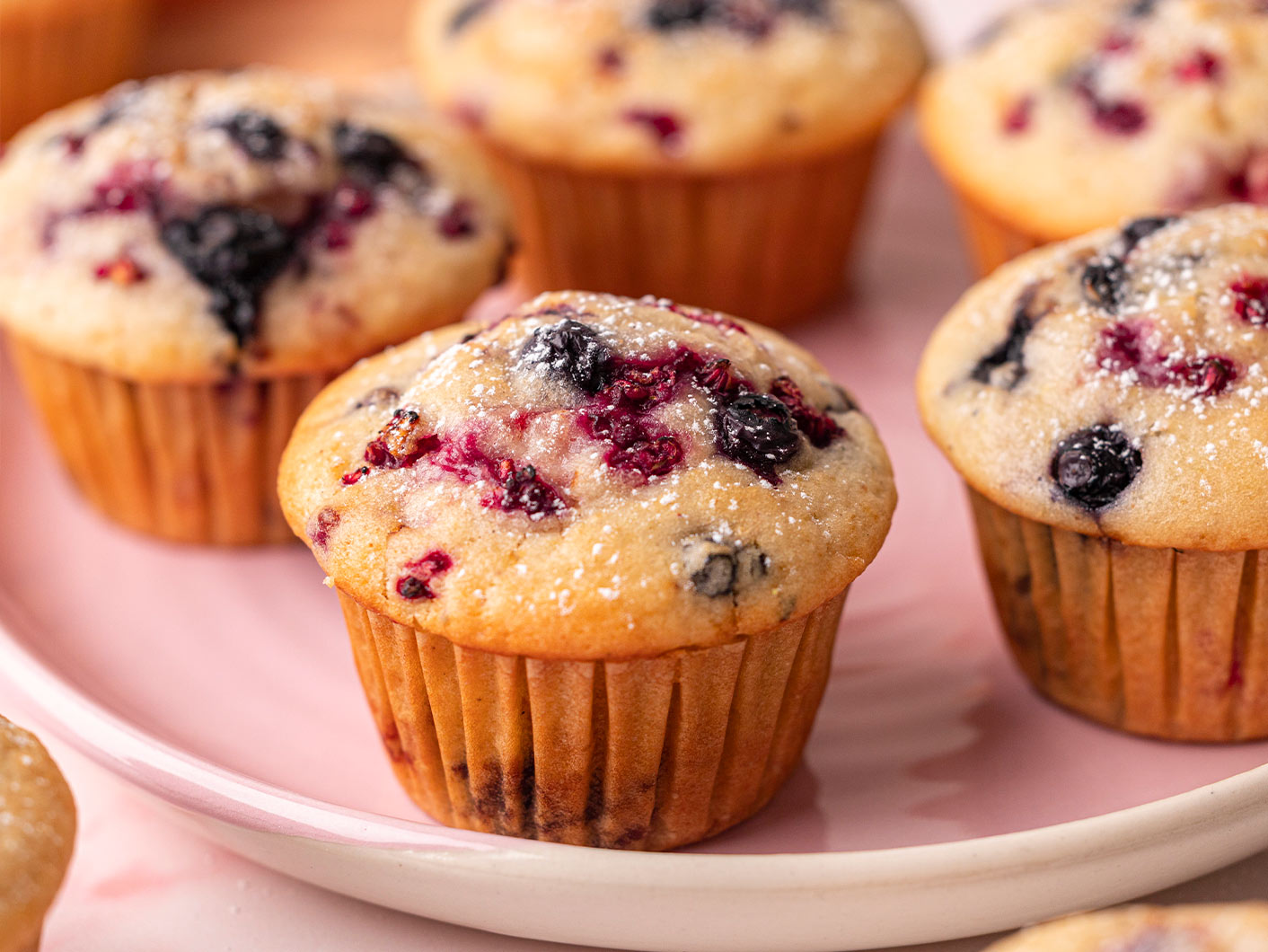
Running from Moms with Muffins

One of the more delightful side effects of having a child in preschool is the parade of parent interactions that comes with it. With the first child, you behave as though you are sending a tiny diplomat into the world: every item is selected with care, from backpack to water bottle to the outfit, and you attend school events with the grave pride of someone seeing a son off to war. By the third child, the standard has slipped somewhat. At that point, success means getting the child to school alive, more or less upright, and with pants on.

So when the notes came home announcing Dads with Donuts and Moms with Muffins, my reaction was less delight than a sort of weary administrative sigh. My husband’s work schedule ruled out the fatherly doughnut contingency. My dad declined as well, which meant the event was quietly promoted, in the way these things often are, to Grandmas with Donuts — much to my four-year-old’s disappointment, though children are nothing if not adaptable when faced with baked goods.

By the time Moms with Muffins rolled around, I felt duty-bound to appear and make up for the male shortage in my family tree. I should say we adore Wynn, but there are only so many pine cone bird feeders a person can assemble before one begins to feel less like a nurturing parent and more like an overtrained assembly-line worker with glue on her sleeves. Besides, I was by far the oldest mother there, which is not so much a social scene as a reminder that I arrived at motherhood by the scenic route. One suspects this may explain why my child runs everywhere, all the time, as though permanently late for a race nobody else knew had started.

Still, there was the muffin. One must be grateful for small mercies. There were also the rotating activity stations, which had the unfortunate effect of requiring actual conversation with other adults — an ordeal I generally try to avoid unless absolutely necessary. Wynn, being a very touchy child, spent the morning clinging, draping, pressing, and generally distributing himself over me like a small and determined octopus. By the end, I was not only thoroughly touched out, but decorated with snot as well, which is really the sort of finish that preschool parent events ought to warn you about in advance.

Moral of the story: all the kids matter, and at this point, sacrificing my own happiness for theirs is practically second nature — especially if there’s a pastry involved.

Running from Daniel Boone

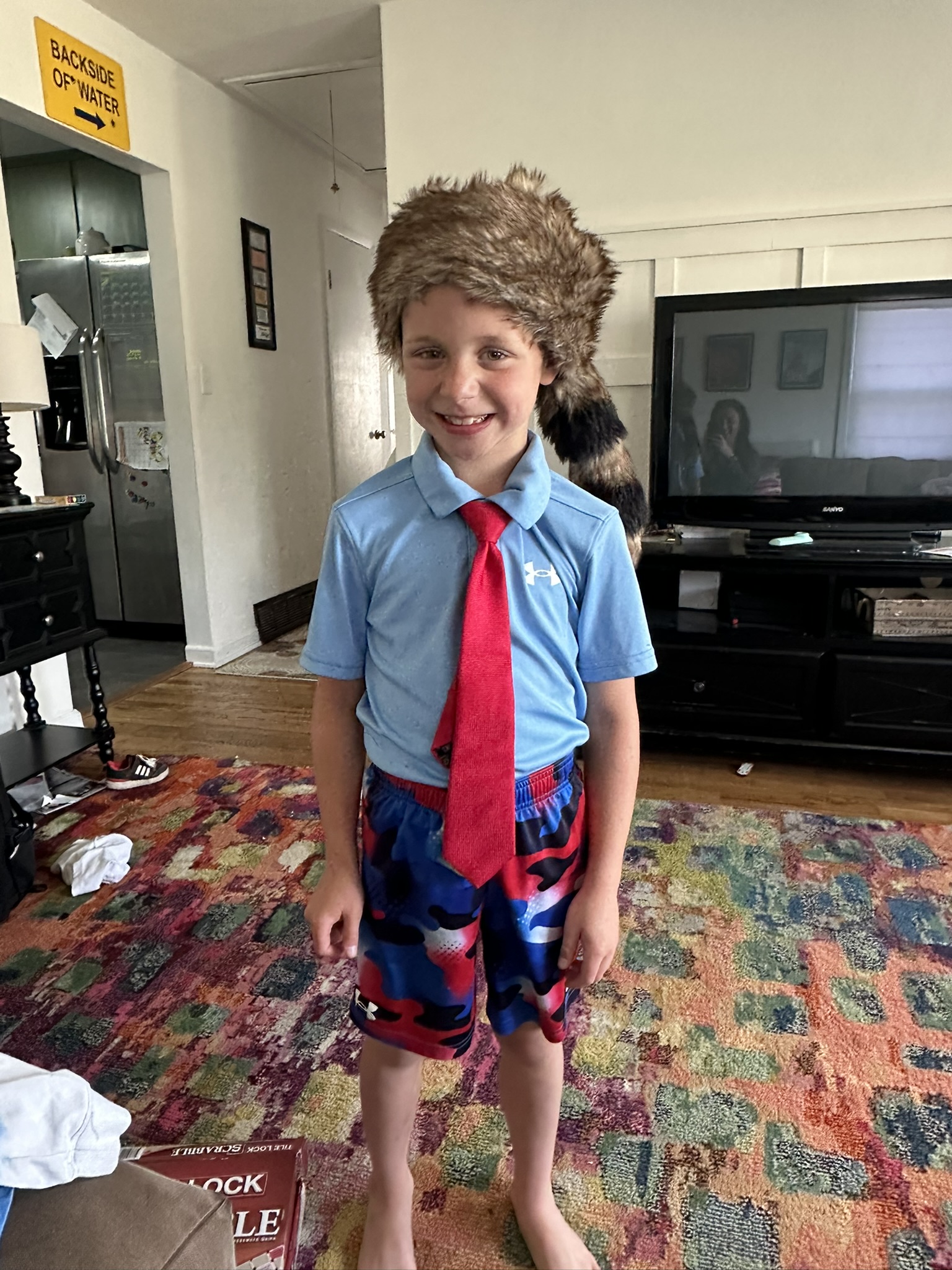
Last night, my 8-year-old had a music program at school, which is the sort of event that reminds me parenting is mostly just a series of logistical challenges disguised as memories. The theme was American Heroes and Legends, and this, naturally, was my favorite part of the entire evening: letting my son choose his own outfit.

He understood the assignment. He knew he needed to look patriotic, but apparently, he also wanted to look like a young gentleman with somewhere important to be. So out he came in a short-sleeve blue polo shirt, red, white, and blue camo athletic shorts, a red tie that zipped around his neck, and a coon skin cap. I did not interfere. Some battles are worth fighting. This was not one of them. Besides, there is a special joy in watching a room full of people smile when they see his little face, especially with the tail of that hat bouncing behind him like it had its own agenda.

School programs, though, are a different matter entirely. I love seeing my kid do his thing, but the rest of it is pure endurance training. There is far too much peopling involved. You have to arrive early enough to secure a decent seat, which is difficult when you are also trying to wrangle siblings, coats, nerves, and the vague feeling that you may have already forgotten something essential. And dragging younger children along is its own special kind of suffering. By the time my son was on stage performing his “number,” the four-year-old announced that he had to poop. I informed him, with the confidence of a woman who had no intention of leaving her seat, that he did not. We remained exactly where we were and watched the show in its entirety.

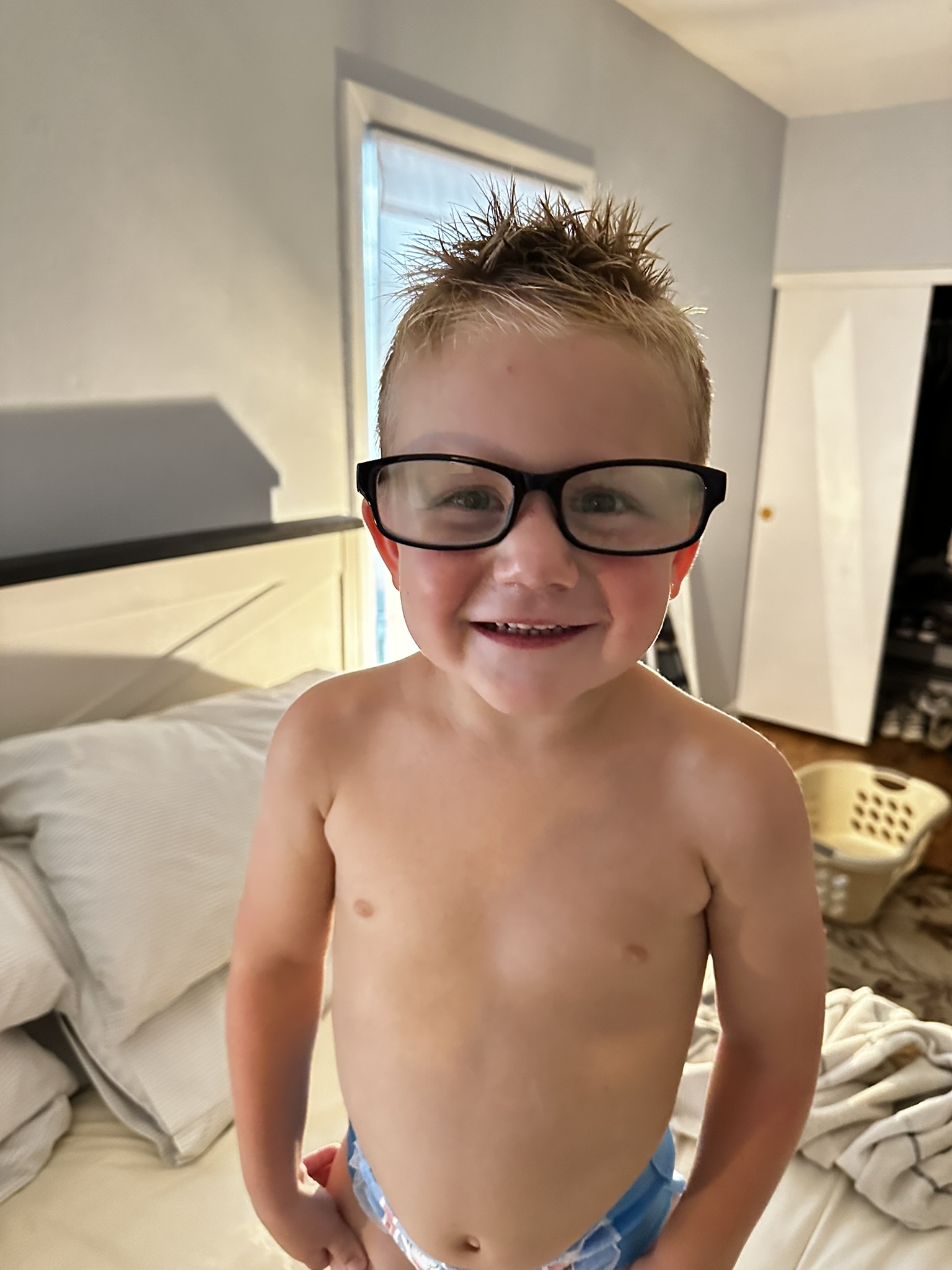
The four-year-old is an odd little fellow in the best and most exhausting way. He seems to believe that leaving the house without a fully stocked supply pack is somehow reckless. Last night, he insisted on bringing a backpack stuffed with a blanket, a stuffed chicken jockey from Minecraft, a small telescope, a plastic hammer, and a bottle of water. I admire the man has a system. I do not, however, admire the part where I eventually have to unpack it all. Every pouch, pocket, and mysterious side compartment becomes my problem in the end.

A mother’s work is never done. Or, if it is, it certainly hasn’t happened in my house yet.

Running from Scorpion Lollipops

In the grand, chaotic theater of parenthood—particularly the boy-mom variety—one becomes accustomed to questions that arrive like uninvited guests at a marathon runner’s post-race buffet: sudden, breathless, and utterly baffling. I was lacing up my running shoes the other day, pondering the simple poetry of pounding pavement, when my youngest burst in, eyes wide as a startled deer’s: “Mom, are scorpion lollipops a good source of protein?” I blinked, mid-stretch, and managed, “You don’t even know what protein is,” at which point he bolted from the room, joyous and carefree as a kid who’s just discovered the turbo boost on life to ask Alexa the same question.

So much of my existence now orbits these interstellar queries, the kind that make a sensible adult pause, much like catching your breath after a grueling hill sprint. To prove the point, consider the interrogations lobbed my way this week alone: Why did the butt go to the doctor? (Presumably for a check-up on its cheeky disposition.) Are the clouds made of cotton candy or just water? (A meteorological dessert, I assured him, but only on Tuesdays.) If I read for eight hours straight, will I turn into an old man? (Only if you skip leg day, I countered.) How many socks do you reckon I can cram onto my head? (Enough to start a laundromat uprising.) What if I skateboarded right over the pizza? (It’d be a supreme topping redistribution exercise.)

I could rattle on—these volleys are endless, like miles unspooling beneath a runner’s steady stride—but I’d spare you the exasperation, that familiar parental cocktail of whimsy and weariness. Part of me adores the sheer, untethered invention of it all, the way their minds gallop free like colts in an open field. Another part yearns to explode, a pressure buildup worthy of a marathoner’s final kick, undone by the gleeful absence of logic. Yet it’s the essence of raising boys: embracing the absurd, answering the unanswerable with a dash of nonsense. It’s rather fun, in truth, concocting replies on the fly—like telling them axolotls only whisper secrets to their mothers. That one circled back to bite me square in the posterior (not the doctor-visiting variety, mind you) when I overheard my son solemnly informing his brother of this “fact,” igniting World War IV in the living room, complete with flying cushions and tactical shrieks.

Therein lies the rub, or perhaps the blister after a long run: these fanciful fictions foster delight but demand vigilance. Still, in the panting aftermath of such skirmishes, I find myself grinning. Parenting boys is less a straight-line race than a trail run—full of unexpected switchbacks, mud puddles of madness, and the occasional scorpion-lollipop curveball that leaves you fitter, faster, and forever questioning your own grip on reality.

Running from the Old Me

How did I—a reasonably sane 42-year-old woman who once fancied herself a college athlete—end up screeching across the dinner table, “Stop saying buttcrack, for the love of God”? It’s a fair question, and the answer, I’m afraid, is that life has a way of sprinting ahead while you’re still lacing up your trainers. None of it was my doing. Not a single humiliating, heart-stopping mile. Call me stubborn if you must, but let me trot out the evidence like so many rogue blisters on a marathoner’s heel.

Exhibit A: Compartment Syndrome, My Five-Year Nemesis (2001–2005)
Ah, college volleyball glory days—until my legs decided to rebel. Chronic compartment syndrome: too much muscle crammed into too small a sheath, swelling like overpacked luggage on a redeye flight. I could barely hobble off the court, pain radiating like I’d run a marathon barefoot over coals. Surgery in 2002? Fizzled like a dud firework. The punchline? I was too fit. My body, that traitorous overachiever, had outgrown its own packaging. Who knew ambition could literally cramp your style?

Exhibit B: The Husband Who Strayed (2015—or Whenever the Heck It Ended)
End of June 2015, baby in arms, no maternity leave, husband off on noble recruiting trips like the dedicated coach he was. Or so I thought. What should have been a relay race through early parenthood turned into a solitary slog through betrayal’s mud pit. The fallout? A wound that festers still, quite possibly the hidden accelerant to that later stroke. Life’s curveballs don’t come with batting practice.

Exhibit C: The NICU Marathon (January 1–21, 2018)
Why my body treats pregnancy like a bad blind date—bolting for the exit before the appetizers arrive—is one of life’s more baffling mysteries. My babies always emerge from the chaos strong, healthy, and perfect as polished trophies, yet my womb seems to regard the whole affair as an unwelcome intrusion, ejecting its precious cargo weeks ahead of schedule. It’s a wretched mismatch, like a marathoner cursed with shoes two sizes too small. That premature arrival turned our world into a 21-day gauntlet of beeping monitors, tiny incubators, and the kind of bone-deep terror that makes every sunrise feel like borrowed time. Touch-and-go doesn’t begin to cover it. He’s thriving now, of course—my little sprinter, outpacing the odds—but those NICU nights remain the slowest, most grueling miles I’ve ever logged.

Exhibit D: The Stroke That Came Out of Nowhere (March 24, 2022)
Picture this: six weeks postpartum, fit as a fiddle, no vices to speak of. I’d never smoked, rarely sipped, and my cholesterol was so pristine you could frame it. Doctors poked and prodded, shrugged their white-coated shoulders, and declared it cryptogenic—a fancy word for “beats us.” Just one of those cosmic pratfalls, like tripping over your own shadow mid-stride. No warning, no fault, just a brain misfiring while I was still catching my breath from new-mom life.

Exhibit E: AFib’s Electrical Gremlins (January 19, 2025)
One ordinary Sunday, my heart decides it’s auditioning for a techno rave. Electrical system gone haywire—no clogged pipes, no dietary sins, no excess poundage. Just faulty wiring in the old ticker, demanding a hospital marathon and surgical pit stop. Here I am, patched up and plodding on, wondering if my body’s secretly plotting a mutiny.

I could keep lapping this track—miscarriages, job upheavals, the daily gauntlet of boy-mom chaos—but what’s the point? Running from everything has left me winded, circling the same bruised shin. No more. I’m grabbing the baton, plotting a new course, even if the map’s half-sketched. Because here’s the truth I’ve pounded into my skull on a thousand solo jogs: you don’t outrun life’s ambushes by fleeing faster. You lace up tighter, pick your stride, and charge toward whatever finish line you damn well choose. Buttcrack or no buttcrack.

Running from 6-7

In a world where you can be anything, be kind—until they say “6-7,” and then, well, all bets are off. That’s my new motto, etched into my boy-mom soul with the same grim permanence as a Sharpie stain on a couch cushion. You know the original saying, the one that sounds like it was dreamed up by someone whose biggest household crisis was a slightly wilted ficus? Mine’s been battle-tested in the trenches of a home where survival sometimes feels like the main event.

Picture this: I’m in the thick of what I call the “keeping them alive” phase of parenting three boys—Cub, Oz, and Wynn, my little whirlwinds of testosterone and poor impulse control. It’s not hyperbole. These kids have elevated “6-7” (you know, that endlessly clever knockoff of the world’s dumbest joke) to a kind of tribal chant. Say it once? Adorable. Twice? Tolerable. By the 47th time before breakfast, I’m wondering if the neighbors would hear a scream or just assume it’s the dog again. Being a boy mom isn’t for the faint of heart; it’s for those who’ve stared down a fart joke epidemic and lived to tell the tale. Poop? Fart? Endless variations on bodily functions? I’ve banned those words so often I sound like a malfunctioning parrot: “Quit saying it! Napkin! Napkin exists for a reason!”

And don’t get me started on selective hearing. You can deliver a State of the Union address about bedtime, and it bounces off them like rain on a raincoat—yet whisper “ice cream” from the next room, and they’re there faster than a Disney Lightning Lane Premier Pass holder. Dinner tables? Forget Norman Rockwell; ours is a spill zone of biblical proportions. Ketchup arcing through the air like a poorly aimed missile, milk pooling mysteriously under chairs—it’s inevitable, like taxes or that one sock vanishing in the dryer. The shirts? Always, always stained, not from heroic spills but from the casual genius of wiping grubby hands right across the chest, napkin be damned. I’ve done laundry loads that could fill a Laundromat, each one a testament to why paper towels were invented.

Then there’s the trail of abandoned gear—water bottles sprouting like mushrooms in every corner of town, jackets draped over bleachers from wrestling meets to soccer fields as if we’re auditioning for a lost-and-found world record. We’ve left behind more Owalas than a hydration influencer. It’s chaos, pure and operatic, the kind that would send a lesser soul fleeing for the hills. But here’s the magic: amid the “6-7” choruses and the perpetual crumbs, there’s this ferocious joy in it. These boys are my tornadoes, my glorious messes, and somehow, in the eye of the storm, I wouldn’t trade a single stained shirt for all the quiet in the world. Kind until 6-7 hits critical mass—then mama roars. Be kind out there, friends. Or at least napkin-adjacent.

Running from Preschool

I suppose I ought to be more distraught today—perhaps even a little melodramatic, clutching tissues and sighing wistfully at family photos—but, apart from my knees muttering unrepeatable things about my running schedule and the Ohio humidity, I’m actually buoyant. Today, my youngest began preschool. This is remarkable not for the educational milestone, but for the subtle breaking of the laws of physics involved: at eight months, he walked out of the living room and straight past the baby stage, like someone late for an appointment. I’ve been waiting for this day with the patience of someone in the world’s slowest Starbucks line, already certain he’d love school, collect a minor fan club, and, with luck, keep his streak as resident class clown.

You can imagine my surprise, then, when he wept at the threshold. Cried. Suddenly, we were the emotional equivalent of the Titanic, and I’d become the ice floe. Part of me—about forty percent, depending on knee status—didn’t want to usher him forward. These transitions, these big-boy milestones, tug harder than anticipated. I mislaid a good chunk of his miniature years, busy patching up my own heart, knees, and other body parts, and now even the universe seems to have pressed fast-forward.

He is, contrary to this morning’s Oscar-worthy scene, ready. I know he’ll be brilliant. But the real snag, if I’m being honest, is called summer. Thanks to a few golden months with his dad and older brothers, my preschooler now suffers from dangerous levels of sibling confidence, convinced his miniature personal assistants are always on call. This is the magic realism of being three. He has no notion that his entourage must soon return to their educational holdings, leaving him more or less abandoned with only me, a healthy snack, and the increasingly bitter complaints of my knees.

By Friday, I expect he’ll ascend to full class celebrity and will start telling people, “Preschool is fine, but the staffing is subpar compared to what I’m used to.” Until then, I’ll be over here—alternating between nostalgia, pride, and speculation about whether it’s possible to put one’s kneecaps in timeout.

Running from Ping Pong Balls

To say the last few days have been a whirlwind would be rather like saying the Titanic had a bit of a leak. On Wednesday evening, I took my mother to the hospital for what was meant to be a harmless little outpatient MRI, the medical equivalent of a quick oil change. We never left. Instead, they discovered a tumor in her right frontal lobe roughly the size and shape of a ping pong ball, which—while delightful on a table with paddles—was considerably less cheery inside someone’s brain.

The worst part was when they yanked me out of the MRI halfway through, deposited me in front of the neurologist, and explained the horror in that brisk, matter-of-fact tone doctors seem to perfect in medical school—equal parts terrifying and unhelpfully calm. I had my three-year-old in tow at the time, who was requesting snacks with the urgency of a union boss, and holding myself together for both of us felt like a feat of Olympic-level emotional gymnastics.

About twenty-five minutes later—during which I tried to deep-breathe myself to a distant, tropical beach unpopulated by rubber gloves and antiseptic odors—they wheeled my mom back out. And then, astonishingly, they made me tell her she had not one, but three tumors in her brain. I don’t know what training program covers this particular duty, but I seem to have missed it. To summarise, it was one of the most excruciating moments of my life—and I say that as someone who has already endured a stroke and heart surgery. Within minutes, my mother had been upgraded to Person of the Hour at the ER, though I doubt she appreciated the honor.

Fast-forward three days, and here we still are. After spending 20 thoroughly disorienting hours in the ER—the sort of place where time passes both too quickly and not at all—they moved her to the neurosurgical floor. Compared with the ER, it’s practically a five-star spa. Coma-inducing lighting, yes, but far fewer crashing alarms. Now we sit and wait for Monday’s brain surgery, a phrase I still struggle to process whenever I say it aloud.

Meanwhile, my heart palpitations, which usually stop by for a polite hello a few times each day, have upgraded themselves to full-time roommates, appearing several times an hour. I haven’t mentioned it to anyone—largely because what could they do besides add it to the mounting pile of things none of us can control? So instead, I hold my breath, because the alternative—falling apart—feels almost indistinguishable from not surviving at all.

And yet, here’s the maddening part: I keep telling myself I can run this away. Every health crisis I’ve had, every checkpoint in this absurd obstacle course of existence, I’ve tried to outpace with running shoes and grim determination. But you cannot log enough miles to outrun brain tumors. You cannot map a route long enough to escape them. The more I try, the more disappointed I am when it doesn’t work. Like a disastrous training run, all stumble and stitch and no joy, I can only hope, truly and stubbornly, that this too shall pass.

Running from Labor Day

September, already?

Honestly, I don’t know how we got here. Somewhere between Memorial Day and Labor Day, time slipped out the back door without so much as a goodbye. One moment I was dutifully buying sunscreen and popsicles, and the next thing I know, we’re knee-deep in sharpened pencils, lopsided backpacks, and the collapse of all illusions that summer still has any life left in it.

Labor Day, for us, was extravagantly uneventful. We made no plans—unless you consider “trying to stop the children from recreating scenes out of a medieval torture manual in the living room” to be plans. Which, in fairness, it probably is. My children have acquired a new pastime: exacting as much physical and emotional damage on one another as possible, all before noon. The soundtrack to this, of course, is a relentless chorus of shrieking, crying, and at least one nosebleed (always the middle child, who, bless him, seems doomed to a life of collateral damage). We have thus far managed to avoid the emergency room, but I can practically feel it penciled onto the horizon of future weekends.

Naturally, the boys would have been perfectly content to spend the entire three days motionless in front of the TV, embalmed in potato-chip crumbs. But, because we are excellent parents—or at least stubborn ones—we forced them outdoors. They ran half-heartedly around the block in under five minutes, returned looking betrayed, and then managed to ask for snacks roughly every three minutes until bedtime. Forty-six snack requests in an afternoon. I did the math.

Now, I like to imagine myself as calm, patient, and capable of handling these miniature crises with grace. This is a delusion. At the tenth spilled cup of juice or the eighth announcement that last week’s “favorite meal of all time” is now “too disgusting to even look at,” something inside me snaps. It’s usually at this point that my husband, recognizing danger, quietly slides into the scene like a diplomatic envoy, defending my honor and ushering me away before I declare dinner a lost cause and start packing my bags for Monaco.

And so here we are: September. A new school year, a new season, and new opportunities to relearn multiplication tables, lose library books, and discover that my children’s capacity for whining is in fact infinite. Still, I’m clinging to the lofty goal of keeping my head—and occasionally even my sense of humor—through it all.

Here’s to a month of beginnings, cooler heads, and hopefully fewer nosebleeds.