Let’s be honest: how many times have you shouted up the stairs, “Are you bleeding?”
If your answer was “daily,” then we have already established the foundation of a meaningful friendship.
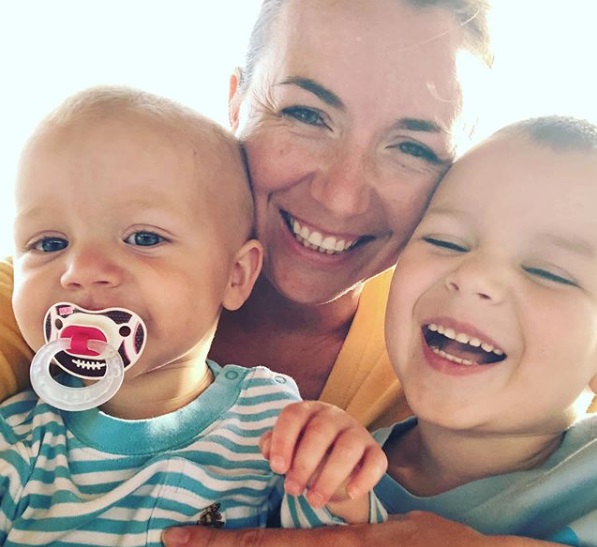
At my house, the response is “YES!” roughly 40 percent of the time, which sounds alarming until you realize that my children are 5 and 2 and are not, as a rule, in possession of a great deal of blood. What they do possess is an instinctive understanding that the word bleeding has a certain urgency to it. It causes a parent to put down whatever they are doing and travel upstairs at once, usually to discover that someone has bumped an elbow, dropped a Lego, or experienced a disappointment of such magnitude that only an adult witness can make sense of it.
After yelling this question approximately one million times during the long, strange months of quarantine—and considering my boys are still only 5 and 2, with decades of household emergencies ahead of us—I began to think about it differently.
I am an overthinker. I can take one small concern and, with enough quiet time and internet access, turn it into a full-scale disaster scenario involving emergency food supplies, school closures, government notifications, and the gradual collapse of civilization. I worry about things that might happen, could happen, or might possibly occur under a very unusual set of circumstances involving poor timing and someone sneezing near a shopping cart.
It is exhausting work.
So recently, I decided to use one simple question to sort through my worries:
But are you bleeding?
It is not a perfect system, of course, but it is surprisingly effective. It helps distinguish between a real emergency and the sort of problem that merely arrives wearing a dramatic hat.
For example, yesterday my husband—who is now an elementary physical education teacher, a development I am saving for another day because it deserves its own chapter—texted me to say that my son’s teacher was quarantining because her husband had tested positive for COVID-19.
My first thought was entirely calm and reasonable.
Then came the questions.
How much time had my son spent with her since she had been exposed?
Her son is in my son’s class, so how much time had the boys spent together?
My son sits next to him. What had they both touched? Pencils? Desks? Glue sticks? The shared classroom air?
Had my younger son been around either of them?
What if we had to quarantine?
Did I have enough food to feed two small boys for two weeks?
And, perhaps most importantly: would quarantine mean that I could sleep in?
The questions kept arriving, one after another, like relatives who have heard there is cake in the kitchen. Before long, I could feel myself slipping into the familiar whirlpool of worry, where every possibility expands until it needs its own zip code.
And that is when I asked myself: But are we bleeding?
In this particular case, there were certainly legitimate concerns. COVID is not something to shrug off. But no one in our home had symptoms. None of us has a pre-existing condition that required immediate panic. Everyone had been wearing masks. We had not been contacted by the health department to quarantine.
So, no. We were not bleeding.
At most, perhaps there was a tiny trickle.
And even a trickle has practical solutions. I could order groceries online and pick them up at Walmart. My mother-in-law could leave supplies on the porch. We could pay attention, act responsibly, watch for symptoms, and take the next right step if something changed.
That is what “stopping the bleeding” looks like: not pretending a concern does not exist, but refusing to turn every concern into a catastrophe before it has earned the right.
Everyone felt fine. No symptoms. No quarantine order. No emergency grocery bunker required.
Winning.
Of course, if we had needed to quarantine, there was still the possibility of sleeping in. That would have been a significant victory, though perhaps not significant enough to justify the rest of the situation. Since we did not have to quarantine, however, I suppose that means I lost that particular round.
So that is how you stop the bleeding in approximately 27 mental steps.
Any questions?
Wait. What was I saying?
Is confusion a symptom of COVID?
And just like that, we are back at the beginning.
Still, no one died. Everyone is okay. And that is worth celebrating.
But Lord, am I tired.