
Running from Ping Pong Balls

To say the last few days have been a whirlwind would be rather like saying the Titanic had a bit of a leak. On Wednesday evening, I took my mother to the hospital for what was meant to be a harmless little outpatient MRI, the medical equivalent of a quick oil change. We never left. Instead, they discovered a tumor in her right frontal lobe roughly the size and shape of a ping pong ball, which—while delightful on a table with paddles—was considerably less cheery inside someone’s brain.

The worst part was when they yanked me out of the MRI halfway through, deposited me in front of the neurologist, and explained the horror in that brisk, matter-of-fact tone doctors seem to perfect in medical school—equal parts terrifying and unhelpfully calm. I had my three-year-old in tow at the time, who was requesting snacks with the urgency of a union boss, and holding myself together for both of us felt like a feat of Olympic-level emotional gymnastics.

About twenty-five minutes later—during which I tried to deep-breathe myself to a distant, tropical beach unpopulated by rubber gloves and antiseptic odors—they wheeled my mom back out. And then, astonishingly, they made me tell her she had not one, but three tumors in her brain. I don’t know what training program covers this particular duty, but I seem to have missed it. To summarise, it was one of the most excruciating moments of my life—and I say that as someone who has already endured a stroke and heart surgery. Within minutes, my mother had been upgraded to Person of the Hour at the ER, though I doubt she appreciated the honor.

Fast-forward three days, and here we still are. After spending 20 thoroughly disorienting hours in the ER—the sort of place where time passes both too quickly and not at all—they moved her to the neurosurgical floor. Compared with the ER, it’s practically a five-star spa. Coma-inducing lighting, yes, but far fewer crashing alarms. Now we sit and wait for Monday’s brain surgery, a phrase I still struggle to process whenever I say it aloud.

Meanwhile, my heart palpitations, which usually stop by for a polite hello a few times each day, have upgraded themselves to full-time roommates, appearing several times an hour. I haven’t mentioned it to anyone—largely because what could they do besides add it to the mounting pile of things none of us can control? So instead, I hold my breath, because the alternative—falling apart—feels almost indistinguishable from not surviving at all.

And yet, here’s the maddening part: I keep telling myself I can run this away. Every health crisis I’ve had, every checkpoint in this absurd obstacle course of existence, I’ve tried to outpace with running shoes and grim determination. But you cannot log enough miles to outrun brain tumors. You cannot map a route long enough to escape them. The more I try, the more disappointed I am when it doesn’t work. Like a disastrous training run, all stumble and stitch and no joy, I can only hope, truly and stubbornly, that this too shall pass.
Running From the Beat of My Own Heart

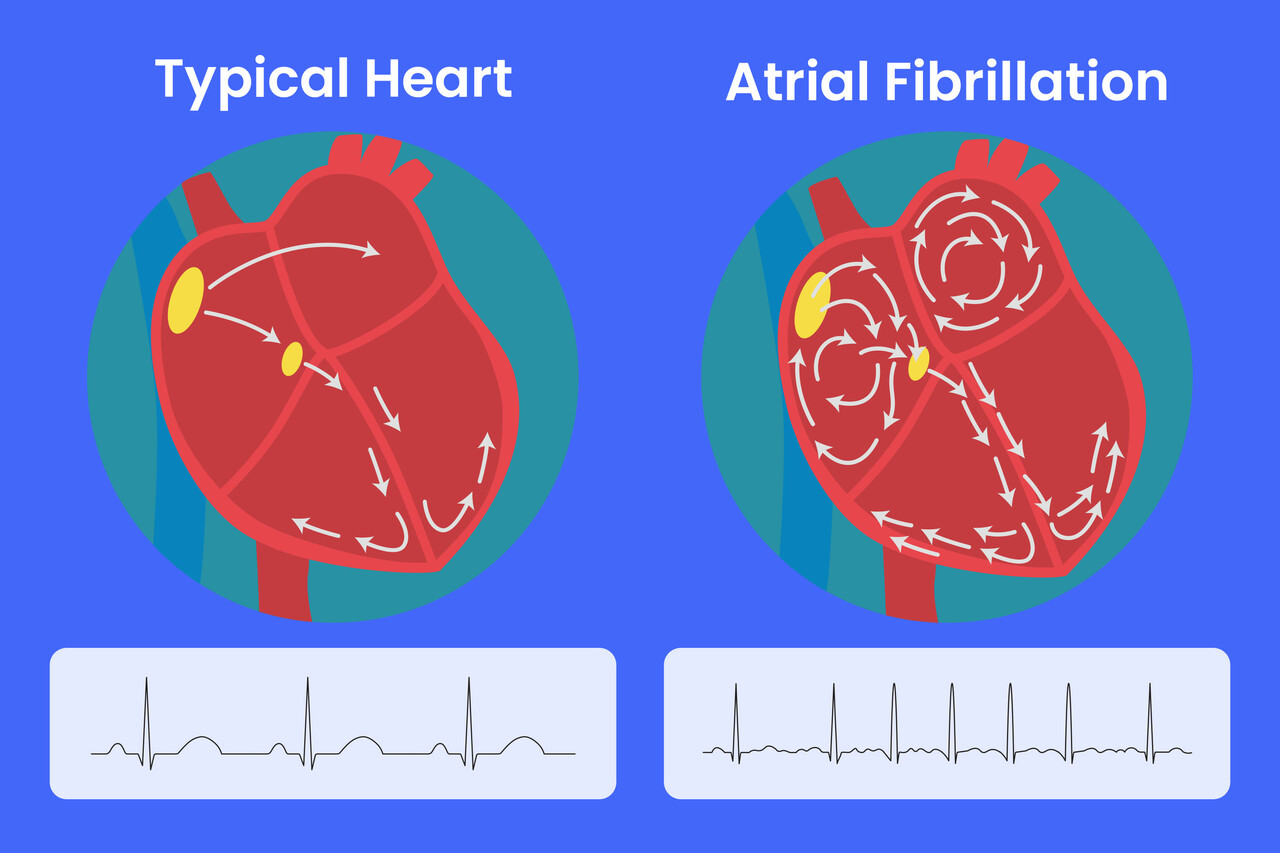
On an otherwise unremarkable Sunday in January, my heart decided it was auditioning for a drum solo in a heavy metal band. It was beating so erratically that I half-expected it to start flashing neon lights. Thankfully, I had my trusty Apple Watch, which promptly informed me that I was in atrial fibrillation—or AFib, as the cool kids call it. Never having experienced this particular thrill ride before, I did what any self-respecting adult would do: I called my mom. Naturally, she dispatched my dad, who happens to be a physician, to come and assess the situation.

Meanwhile, my husband was an hour away at a wrestling meet with our son, leaving me at home with a seven-year-old and a three-year-old. The idea of dragging them to the ER was laughable—imagine trying to explain to triage why one child is climbing the IV stand while the other is attempting to commandeer the defibrillator.

Dad arrived but couldn’t make heads or tails of my heart’s newfound jazz improvisation. He stuck around for a bit to make sure I didn’t keel over, and since the chaotic rhythm eventually subsided, I decided to spend the rest of the afternoon lying low on the couch. It was not exactly how I’d envisioned my weekend.

Hours later, when my husband finally returned home, my heart decided it wasn’t done with its antics. This time, it felt like it was attempting to launch me into orbit with its out-of-sync throbbing. Dad came back for Round Two of “What Is My Daughter’s Heart Doing Now?” and after 20 minutes of watching my pulse behave like a malfunctioning metronome, he declared it was time for the ER.

The car ride was a blur of breathlessness and sheer terror. I’d read enough about AFib to know it wasn’t something you wanted to mess around with—another stroke and cardiac arrest weren’t exactly on my bucket list. By the time we arrived at the hospital (mercifully empty), they whisked me straight into triage for an EKG. My heart rate was doing its best impression of a roller coaster: up, down, loop-de-loop.

In no time, I found myself hooked up to an array of machines that beeped ominously, as though auditioning for a sci-fi movie soundtrack. My heart rate settled at a steady 135 beats per minute but occasionally dropped into the 70s just to keep the nurses on their toes. Eventually, they dosed me with medication that calmed things down enough for me to be admitted.

And let me tell you, there’s no lonelier place on Earth than a hospital room at night. My husband went home to stay with the kids—it was Martin Luther King Jr. Day the next morning, so at least there wasn’t school to worry about—but that left me alone with nothing but my thoughts and an endless parade of nurses interrupting any attempt at sleep.

After three days of tests and sleepless nights, the verdict was in: my AFib wasn’t caused by anything as fixable as diet or exercise but rather by an electrical glitch in my heart. The solution? A cardiac ablation scheduled for the end of the month—because nothing says “fun” like heart surgery.

In the meantime, I’ve been navigating life on new medication while trying not to panic every time my heart skips a beat. Running—my beloved escape—has taken a backseat to teaching my kids how to dial 911 and writing a will (just in case). It’s a strange limbo: part fear of what’s next and part determination to savor every moment until then.

Perhaps this is where all those miles I’ve run have led me—not away from problems but straight into their arms. It feels unfair sometimes, like my body has betrayed me after years of taking care of it. But until someone invents an alternative to living, I’ll keep showing up for this messy, unpredictable life.