Running from Holidays

It’s a peculiar thing, really—this unwritten law that mothers must moonlight as the chief engineers of all holiday enchantment. If there’s a magical event on the calendar, odds are I’m the one quietly orchestrating it from behind the curtain, like some seasonal Imagineer with a glue gun and a to-do list. Santa Claus? That’s me. Easter Bunny? Also me. Leprechaun? For reasons as mysterious as the origins of Figment, yes, me again. Meanwhile, my husband approaches Christmas morning with the same wide-eyed astonishment as a tourist discovering a second entrance to EPCOT—utterly delighted, blissfully unaware, and, crucially, not the one who wrapped the monorail set.

Last Christmas, my oldest, in a moment of honesty only a child or a particularly blunt park guest can muster, asked if perhaps I’d been a “bad girl” since Santa had forgotten to bring me anything. I shot my husband a glare so frigid it could’ve closed Blizzard Beach for the season, then shrugged and moved on. Sometimes, you have to pick your battles, especially when your only weapons are tinsel and a patience level that’s dropping faster than Rise of the Resistance boarding groups.

Now, if you think holiday magic is just a matter of popping into Target and grabbing whatever’s on the endcap, let me assure you: this is a covert operation of the highest order. My children are drawn to hidden presents like guests to free Wi-Fi, and will sniff out even the best-laid plans with the tenacity of a Disney blogger hunting for soft openings. Thus, I’ve developed hiding spots so ingenious that I occasionally lose track of them myself, leading to the annual spring tradition of “Why is there a Hatchimals egg in the linen closet?”

And let’s talk about the gifts themselves. There is a very specific subset of toys—tiny plastic things, anything that shrieks, and games requiring adult participation—that I avoid with the same fervor I reserve for rope-dropping a park on a holiday weekend. There’s only so much forced merriment one can endure before considering a strategic retreat to the garage with a mug of something “festive.”

So, here’s to the mothers: the unsung Imagineers of the festive season, the ones who keep the magic alive, year after relentless year. And let us not forget our shared, silent loathing for that infernal Elf on the Shelf, who, much like a malfunctioning animatronic, always seems to cause more trouble than he’s worth.

Happy holidays, and may your patience last longer than the line for Peter Pan’s Flight.

Running from the Dentist

I hate the dentist. I mean, truly, deeply, passionately hate the dentist. If there were an Olympic event for avoiding dental appointments, I’d be a gold medalist, standing proudly atop the podium with a plaque commemorating my years of dodging fluoride treatments and awkward small talk about flossing. It’s not just the discomfort of the experience—it’s the sheer absurdity of willingly choosing to spend your days poking around in other people’s mouths. What kind of person wakes up one morning and thinks, You know what? I want to peer into cavities for a living! Surely, there’s some sort of psychological study waiting to be done on this.

My last visit to the dentist was right before my stroke—a momentous occasion that now feels like a grim punctuation mark in my personal timeline. Afterward, life became a whirlwind of chaos: a cross-country move, a new job, the exhausting process of finding new doctors. Dental care somehow fell to the bottom of the priority list, buried beneath layers of more pressing concerns. Fast forward three years, and here I am—mouth so numb after finally biting the bullet (pun intended) and going back that I could gnaw on barbed wire without flinching. It’s both horrifying and oddly liberating.

Teeth are terrifying little things when you think about them. They’re like tiny landmines hiding in your gums—silent, unassuming, and ready to explode into pain at any moment. Things break without warning. You wake up one day feeling fine and by lunchtime you’re Googling “sharp pain in molar” while spiraling into existential dread. And then there’s the dentist themselves—a mysterious figure armed with drills and mirrors who speaks in cryptic terms about “pockets” and “enamel erosion.” You nod along as though you understand, but really you’re thinking, Are they just making this up? Should I trust them?

Let’s not forget the sheer indignity of dental procedures. They numb you up until your face feels like it’s been replaced with a slab of concrete, or worse, they knock you out entirely. Laughing gas? Don’t get me started. It’s like being invited to a party where you’re the only guest who doesn’t know what’s happening. You leave feeling compromised—unable to eat properly or form coherent sentences—and wondering if this is what defeat feels like.

Doctors aren’t much better, though they do have slightly less terrifying tools at their disposal (no drills, thank goodness). But visiting them is its own kind of ordeal—wandering through sprawling facilities that feel more like labyrinths than places of healing. You sit there in sterile rooms while they poke and prod, never quite sure what they’re looking for or whether your headache is just a headache or an ominous sign that something catastrophic is brewing. And let’s be honest: Googling symptoms is practically an act of self-sabotage. One minute you’re searching “sore throat,” and the next you’re convinced you have six months to live.

And then there are the accessories—the rubber gloves snapping ominously against wrists, the surgical masks muffling voices into eerie half-murmurs, and those bizarre magnifying glasses that make doctors look like they’ve wandered off the set of a sci-fi film. It’s all so unsettlingly clinical that you can’t help but wonder if they’re secretly auditioning for roles as mad scientists.

In short: dentists are scary, doctors are slightly less scary but still unnerving, and teeth are downright treacherous little monsters lurking in your mouth. If I could opt out of all of it entirely—teeth included—I’d seriously consider it.

Running from Dinner

Being a mom is, to put it mildly, like being the CEO of a company where the employees are perpetually confused, demanding, and prone to losing their shoes. It’s not that being a dad isn’t hard—dads have their own set of challenges—but moms are expected to know everything. We’re the keepers of the appointments, the grocery lists, and the precise location of every sock in the house. We’re also tasked with feeding everyone dinner every single day (as if hunger weren’t enough of a problem without adding meal planning to it) and ensuring there’s always underwear for the foreseeable future. Honestly, it’s a wonder we don’t just throw in the towel and declare cereal as an acceptable dinner option every night. Thank goodness my kids like cereal.

And yet, my responsibilities don’t stop with the kids. Oh no, I also worry about my husband’s stuff. Did his co-workers like him today? Does his boss think he’s doing a good job? Did he remember his coffee mug this morning? These are not things I need to worry about, but I do anyway because apparently my brain has decided it’s a good idea to run on overdrive at all times. The result? Exhaustion. Most days I’m so drained I can fall asleep before my kids do—though, admittedly, the stroke hasn’t helped matters in that department. By 8 p.m., I’m done for, and I’ve stopped pretending otherwise.

As if all that weren’t enough, volleyball has added a new layer of mental gymnastics to my life. Coaching requires brainpower—lots of it—and that makes my already pronounced exhaustion even more pronounced. It’s as though life decided to hand me a wrench and then gleefully watch me try to juggle it along with everything else.

And can we talk about dinner for a moment? Who decided moms need to be responsible for answering all food-related questions? “What’s for dinner?” “Do we have ketchup?” “Why don’t we have ketchup?” How am I supposed to remember if there’s another bottle in the pantry when you inhaled the last one like it was oxygen? The whole thing is absurd.

This is why running is my ultimate sanctuary. It allows me to escape the chaotic landscape of my mind—a realm cluttered with endless lists, nagging reminders, and mental post-it notes that seem to multiply like rabbits on caffeine. For a blissful stretch of time, I get to silence the cacophony of thoughts and simply be. It’s a liberating experience that reminds me I still possess a semblance of sanity.

And when I return home, something magical happens. The tasks that once loomed like Mount Everest now seem like mere speed bumps. Running is hard, yes, but it’s a reminder that if I can conquer the road, I can conquer anything life throws at me. Plus, it’s the ultimate multitasking tool: I can listen to podcasts, push kids in strollers, run with the dog, and rack up my steps all at once. It’s efficiency at its finest—a symphony of productivity and peace.

So here’s my conclusion: running is not just a survival tool for moms; it’s a lifeline. It’s not just exercise; it’s therapy, a sanity-saver, and a reminder that we’re capable of more than we ever thought possible. Vote for me in 2028, and I’ll make sure cereal dinners and mandatory running become the pillars of a new national wellness policy. Together, we can create a world where moms can thrive, one run at a time!

Running from the Toddler

Ah, motherhood. That grand, mysterious adventure that begins with nine months of discomfort, followed by a brief stint as a conveyor belt for tiny humans and culminates in the realization that your life is now entirely dictated by someone who can’t tie their own shoes. The remarkable thing about this whole process is how quickly we forget the pain—the swollen ankles, the sleepless nights, the moment you realized your bladder had been demoted to a trampoline. It’s as if nature has thoughtfully provided us with a mental delete button. But then, just when you think you’ve moved on, along comes the age of three to remind you that perhaps you haven’t forgotten quite enough.

Now, people often talk about the “terrible twos,” which is misleading. Two is merely an amuse-bouche of chaos compared to the full buffet of madness that awaits at three. Three is when your cherubic toddler transforms into a pint-sized dictator with an alarming grasp of language and an uncanny ability to manipulate adults. They don’t just demand hot dogs; they demand them with conviction. They don’t just want you to play; they want you to be exactly the Transformer they’ve assigned while they prance about as Slinky Dog. And heaven help you if you don’t queue up their favorite show for the 87th time—an oversight that will be met with outrage worthy of a United Nations summit.

I can say with confidence that I despise three-year-olds—my own included. It’s not personal; it’s just that they’ve perfected the art of being simultaneously exhausting and infuriating. They refuse naps, despite being visibly more tired than a marathon runner at mile 26. They develop peculiar preferences for things like milk cups, which they express in cryptic proclamations like, “That’s more like it!”—a phrase so bizarre it makes you wonder if you’re raising an eccentric Victorian aristocrat.

But let me assure you, it doesn’t stop at three. Oh no, seven and nine have their own unique horrors. Seven-year-olds seem to think sibling rivalry is an Olympic sport, and nine-year-olds have mastered the fine art of being insufferably smug while still needing help with basic hygiene. If I had a dollar for every time I’ve shouted “Keep your hands to yourself!” I’d be lounging on a private island right now, sipping cocktails and marveling at my fortune.

This is why I run—not metaphorically or figuratively—but literally. Running is my escape from the madness, my chance to pound out my frustrations on the pavement while fantasizing about a world where children come with mute buttons. Lexapro helps, but even modern pharmaceuticals have their limits when faced with preschoolers who think they’re ready to govern small nations.

Still, hope glimmers faintly on the horizon: preschool starts in the fall. Surely someone else can deal with his boundless energy and insatiable curiosity for a few hours each day. Until then, I’ll be here—dodging demands for hot dogs and Transformer reenactments—counting down the days until sanity returns (or at least takes a brief holiday).

Running from the Geese

There is a bit of an avian drama unfolding just outside my workplace, and it is nothing short of a Hitchcockian spectacle. A Canadian goose—a bird whose reputation for belligerence precedes it—has decided that the ideal spot to lay her egg is mere inches from one of our entrance doors. This, as you might imagine, has turned the simple act of entering the building into something akin to running a gauntlet.

The father goose, a creature of singular determination and misplaced aggression, has taken it upon himself to defend their makeshift nursery with the fervor of a medieval knight guarding a castle. To him, every passerby is an existential threat, and he greets them with all the subtlety of a dive-bombing fighter jet. Colleagues have been subjected to aerial assaults, honking tirades, and the occasional goose-to-head collision. It’s less “welcome to work” and more “welcome to Thunderdome.”

I, however, have managed to avoid being attacked. Perhaps it’s my aura of invincibility. Or perhaps I’ve simply been lucky enough to avoid crossing paths with this feathered vigilante on a bad day. Either way, I’ve had time to reflect on this goose’s antics and come to one undeniable conclusion: that bird is an exceptional parent. He would do absolutely anything for his unborn offspring—even if it means terrorizing an entire office building.

It’s humbling, really. There are days when I can’t even muster the energy to fetch my child a cold hot dog from the fridge. And here’s this goose, risking life and limb (well, mostly limb) to protect an egg. What kind of mom am I? Sure, I made my kids by eating food—a fact I like to remind them of regularly by declaring that their arms are made of barbecue chips—but they never believe me. It’s true though!

When I was pregnant with Cub, for instance, I subsisted almost entirely on Raisin Bran. Why? I have no idea. But I went through boxes of the stuff like it was going out of style. On one particularly memorable trip to California during that pregnancy, I ate nothing but Raisin Bran for four days straight. It was probably the cheapest vacation diet in history.

With Ozzie, my cravings pivoted dramatically to all things orange—orange Jell-O, oranges themselves, anything vaguely citrus-hued. Perhaps my body was crying out for Vitamin C? Who knows?

And then there was Wynn. For reasons I cannot explain (nor do I want to), all I craved during that pregnancy was concession stand nacho cheese—the kind that comes in plastic tubs and tastes like regret but somehow hits all the right notes when you’re expecting. Unsurprisingly, Wynn turned out to be my heavyweight.

Despite these peculiar dietary choices, all three kids turned out perfectly fine—living proof that you can build a human on cereal, citrus, and questionable cheese products.

But back to our goose friend: as much as her dedication impresses me, I can’t help but feel grateful that human parenting doesn’t require sitting on your children all day long like she does with her egg. That said, if anyone needs me later today, I’ll be sneaking into work through the back door while silently saluting Mr. Goose for his unyielding commitment to fatherhood—and hoping he doesn’t notice me on the way in!

Running from April Fools

I am, it seems, eternally surrounded by boys. Not just metaphorically, mind you—literally. They’re everywhere. I have three sons of my own, a husband who occasionally behaves like a fourth, and now, as if the universe thought I needed more chaos in my life, I’m coaching a boys’ volleyball team this spring. It’s as though some cosmic force has decided that my life’s soundtrack should be an endless loop of the word poop. Truly, the frequency with which I hear that word on any given day is enough to make even the most patient saint consider early retirement.

But here’s the thing about boys: they’re surprisingly easy to manage once you crack the code. Sure, they’re loud, messy, and occasionally baffling creatures, but they’re also refreshingly straightforward. Over the years, I’ve made a few observations about living in this testosterone-fueled circus. Consider this your guide to boy-wrangling:

1. They’re Predictable (Mostly)

Boys don’t tend to be particularly devious. They’re not plotting elaborate schemes or engaging in Machiavellian mind games. If you know where the dangers lie—sharp corners, precariously stacked objects, or that one kid who thinks he’s invincible—you can usually keep them in one piece. It’s less about strategy and more about constant vigilance, like living with a pack of hyperactive puppies.

2. The Five-Second Rule is Irrelevant

If it’s edible (or even vaguely resembles food), they’ll eat it. Dropped it on the floor? No problem. Found it under the couch? Even better! Boys have stomachs of steel and appetites that defy logic. I once saw one of mine eat half a sandwich he’d forgotten in his backpack for two days without so much as a second thought—or a stomachache.

3. They Speak First, Think Later

If there’s a filter between their brains and their mouths, it’s either malfunctioning or nonexistent. This habit is particularly grating to any girl within earshot, who will inevitably roll her eyes and mutter something about how boys are hopeless. And honestly? She’s not wrong.

4. Rocks Are Their Currency

I don’t know how or why this happens, but boys collect rocks as though they’re precious gemstones. You’ll find them everywhere—backpacks, pockets, jars, under couch cushions. Sometimes they’re special because they’re “shiny” or “cool,” but more often than not, they’re just regular old rocks that somehow hold immense sentimental value.

5. Practical Jokes Are Their Love Language

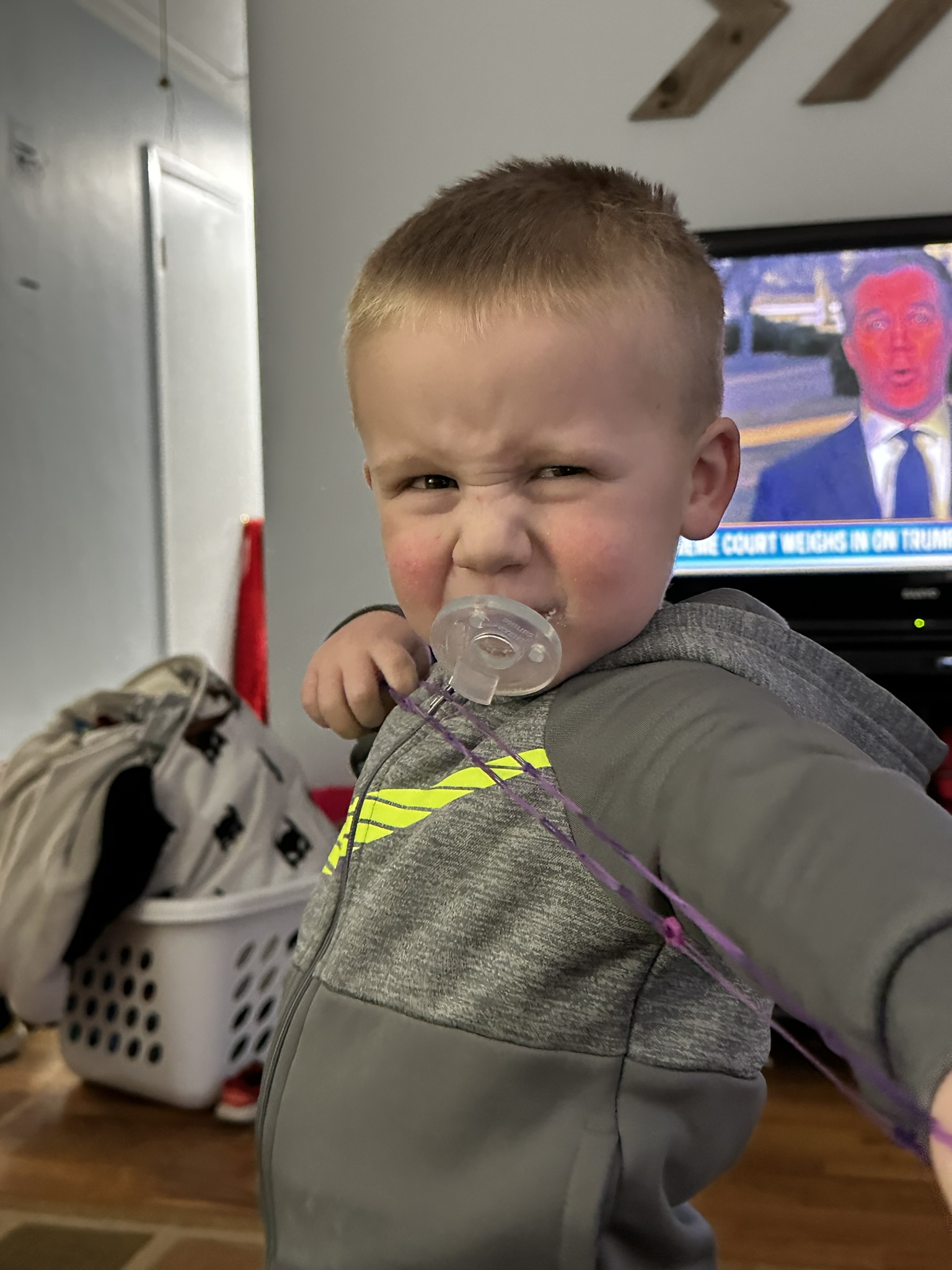
In my house, pranks are as essential as oxygen. As I sit here writing this from work, there is packing tape stretched across every doorway in my home—a delightful surprise left by my little April Fools enthusiasts. My mom has already reported that one of them walked straight into it (the irony is not lost on me). By the time I get home at 5:30 p.m., I fully expect to find at least one child tangled in tape like a fly caught in a spiderweb. This is my life.

And yet, despite the chaos—the noise, the messes, the endless supply of rocks—I wouldn’t trade it for anything. Life with boys is unpredictable and exhausting but also wildly entertaining. They keep me on my toes and remind me daily that laughter really is the best medicine… even if it’s occasionally at my own expense.

So here’s to boys: messy, lovable tornadoes of energy who will forever keep me guessing—and forever keep me laughing (even if it’s through gritted teeth).

This, folks, is why we run. I realize that April Fools’ Day is a metaphor for life itself—full of unexpected twists and turns, some humorous, others not so much. But running gives me the clarity to navigate these challenges with a bit more grace and a lot more humor. So, on this April Fools’ Day, I’ll keep running—both from the pranks and towards a clearer mind. After all, this is why we run: to find our footing in a world that’s always trying to trip us up.

Running from Reality: A Midlife Meander Through the Absurd

Let’s talk about expectations. When you’re knee-high to a grasshopper, do you envision yourself, decades later, as a 42-year-old survivor of both a stroke and the relentless existential dread that comes with being a modern human? Do you foresee a domestic landscape populated by a nine-year-old space expert (who knows more about black holes than I do about, well, anything), a six-year-old bottomless pit of a child (whose digestive system operates with the efficiency of a garbage disposal), a three-year-old dictator (who probably runs a tighter ship than most Fortune 500 CEOs), and a husband whose devotion to wrestling occasionally surpasses even his fondness for his long-suffering wife?

No? Me neither.

Life, as they say, has a way of rearranging the furniture. It presents you with a neatly packed suitcase of dreams and aspirations, then promptly throws it off a speeding train. You’re left standing on the platform, blinking in confusion, surrounded by scattered socks and a crumpled map of the world as you thought it would be.

And so, one finds oneself at an… interesting juncture. Not ungrateful, mind you. Gratitude is a very important thing and I practice it daily. But also not… entirely thrilled. Frankly, some days, the sheer weight of it all—the demands, the responsibilities, the unrelenting cacophony of tiny voices—can feel like trying to swallow a particularly dense and thorny cactus.

This, dear reader, is where the running comes in.

Because when life serves up a generous helping of the unexpected, you have two choices: you either roll over and play dead, or you lace up your sneakers and attempt to outrun the encroaching sense of… something. What that something is, I’m still trying to figure out. Midlife crisis? Existential angst? The lingering effects of neurological trauma? Probably a delightful cocktail of all three, shaken, not stirred.

Now, about that cactus. You could try to stomach it whole and learn to appreciate its unique flavor profile (a flavor that, I suspect, closely resembles despair). Or, you could opt for a slightly more palatable solution. Which is, in my case, a small, round, Lexapro-shaped lifesaver. Remember that thorny cactus? Well, this little pill helps to smooth down the spikes. Not a cure, mind you. More of a… temporary truce.

The reality, as I’m slowly coming to accept, is that some days the chatter in my head resembles a flock of startled parrots engaged in a heated debate about the merits of various brands of birdseed. Other days, it’s more like a swarm of angry bees, buzzing furiously around a nest of anxieties. Saturdays, in particular, can be perilous. With the structure of the workweek stripped away, and the schedule blissfully (or terrifyingly) sparse, there’s simply too much time to think. Too much time to ruminate. Too much time to engage in the delightful pastime of self-loathing.

The medication has quieted the noise, and the relief is palpable. But it’s also… unsettling. I’m calmer. Less anxious. Something I haven’t felt in years. It feels a little like wearing someone else’s skin.

Here’s the kicker: I’m still trying to figure out who “I” am now. The stroke, the medication, the relentless march of time—they’ve all conspired to create a somewhat… unfamiliar version of myself. I don’t quite recognize myself. I haven’t been myself in about three years now, and I’m still trying to figure out where the trail leads. Am I back to myself? Am I a new version? Am I just out here, aimlessly running?

But this, surprisingly, is a happy post. Because in the midst of all this uncertainty, there’s a glimmer of something resembling hope. A sense of relief. The freedom to breathe, even if the air feels a little… different.

And, dear reader, you’re getting to witness it all unfold. As I stumble and fumble my way through this new normal, as I tentatively piece together the fragments of my former self, I’m sharing it all with you. You’re getting the real-time, uncensored, occasionally-slightly-medicated revelation of me. Aren’t you just thrilled? I know I am. Mostly. Well, sometimes. Okay, maybe only on Tuesdays. But still… progress!

Now, if you’ll excuse me, I have a three-year-old dictator to appease. And a five-mile run to “escape” into. Wish me luck. I have a feeling I’m going to need it.

But are you bleeding?

Let’s be honest: how many times have you shouted up the stairs, “Are you bleeding?”

If your answer was “daily,” then we have already established the foundation of a meaningful friendship.

At my house, the response is “YES!” roughly 40 percent of the time, which sounds alarming until you realize that my children are 5 and 2 and are not, as a rule, in possession of a great deal of blood. What they do possess is an instinctive understanding that the word bleeding has a certain urgency to it. It causes a parent to put down whatever they are doing and travel upstairs at once, usually to discover that someone has bumped an elbow, dropped a Lego, or experienced a disappointment of such magnitude that only an adult witness can make sense of it.

After yelling this question approximately one million times during the long, strange months of quarantine—and considering my boys are still only 5 and 2, with decades of household emergencies ahead of us—I began to think about it differently.

I am an overthinker. I can take one small concern and, with enough quiet time and internet access, turn it into a full-scale disaster scenario involving emergency food supplies, school closures, government notifications, and the gradual collapse of civilization. I worry about things that might happen, could happen, or might possibly occur under a very unusual set of circumstances involving poor timing and someone sneezing near a shopping cart.

It is exhausting work.

So recently, I decided to use one simple question to sort through my worries:

But are you bleeding?

It is not a perfect system, of course, but it is surprisingly effective. It helps distinguish between a real emergency and the sort of problem that merely arrives wearing a dramatic hat.

For example, yesterday my husband—who is now an elementary physical education teacher, a development I am saving for another day because it deserves its own chapter—texted me to say that my son’s teacher was quarantining because her husband had tested positive for COVID-19.

My first thought was entirely calm and reasonable.

Then came the questions.

How much time had my son spent with her since she had been exposed?

Her son is in my son’s class, so how much time had the boys spent together?

My son sits next to him. What had they both touched? Pencils? Desks? Glue sticks? The shared classroom air?

Had my younger son been around either of them?

What if we had to quarantine?

Did I have enough food to feed two small boys for two weeks?

And, perhaps most importantly: would quarantine mean that I could sleep in?

The questions kept arriving, one after another, like relatives who have heard there is cake in the kitchen. Before long, I could feel myself slipping into the familiar whirlpool of worry, where every possibility expands until it needs its own zip code.

And that is when I asked myself: But are we bleeding?

In this particular case, there were certainly legitimate concerns. COVID is not something to shrug off. But no one in our home had symptoms. None of us has a pre-existing condition that required immediate panic. Everyone had been wearing masks. We had not been contacted by the health department to quarantine.

So, no. We were not bleeding.

At most, perhaps there was a tiny trickle.

And even a trickle has practical solutions. I could order groceries online and pick them up at Walmart. My mother-in-law could leave supplies on the porch. We could pay attention, act responsibly, watch for symptoms, and take the next right step if something changed.

That is what “stopping the bleeding” looks like: not pretending a concern does not exist, but refusing to turn every concern into a catastrophe before it has earned the right.

Everyone felt fine. No symptoms. No quarantine order. No emergency grocery bunker required.

Winning.

Of course, if we had needed to quarantine, there was still the possibility of sleeping in. That would have been a significant victory, though perhaps not significant enough to justify the rest of the situation. Since we did not have to quarantine, however, I suppose that means I lost that particular round.

So that is how you stop the bleeding in approximately 27 mental steps.

Any questions?

Wait. What was I saying?

Is confusion a symptom of COVID?

And just like that, we are back at the beginning.

Still, no one died. Everyone is okay. And that is worth celebrating.

But Lord, am I tired.

The harsh realities of parenthood

Screenshot 2018-08-26 18.52.54I think one of my biggest fears in life is being the person that people dread walking in a room. And that’s not to say I want to be liked by everyone. That is impossible. Plus I hate most people, so I don’t expect them all to like me. But in this sense I mean walking into a room with my kid and someone whispering to the person next to them, “Oh no. Not them.”

Now, to clarify, when my boys start wrestling, and they walk into the gym I want everyone and their dog to say, “Oh No. Not the Thompson boys!” I just don’t want people saying that when we walk into pre-school, which happens to be the exact situation I currently find myself in. We are starting week 3 of pre-school with Cub. Let me just throw a few items out there so people know the situation:

  1. Cub turned 3 on June 28th.
  2. We don’t necessarily expect to send him to kindergarten when he is 5. We think 6 is probably going to be better for him maturity wise (and athletically).
  3. He has been potty trained for 4 weeks, but took to it like a champ and has only had 2 accidents in his 8 days. One of those accidents was during nap time, and the other was because the teacher didn’t get his pants off of him quick enough in the bathroom (yes, he still needs some help with the clothing stuff). I am not blaming the teacher…
  4. Last Sunday he had what I would consider a significant head injury. He was ankle tackled by a friend at a birthday party and smacked his head on a chair, I mean HARD, right across the bridge of his nose and left eye.
  5. He had just started talking around the first of May. He is hard to understand, but he is repeating everything you say and has a pretty good vocabulary if you listen to him. His annunciation is not great yet, but the difference from 6 months ago to now is REMARKABLE.
  6. Cub does have tantrums. He likes to get his way, but I in no way think that these are any different from most kids.

The first week of pre-school was challenging for Cub. It was the first time he went anywhere all day, all week. He was still sort of potty training so the whole situation was new for him. I got multiple calls from the teacher, checking in, talking about a tantrum or two he had thrown, but everything was pretty normal from my perspective.

Screenshot 2018-08-26 18.53.00Week two started out terrible. I was having a very rough day at work, went to pick Cub up at 5 and was bombarded with a swift, “We think Cub should go home from 11-2 for lunch and nap. He can be here from 8-11 and 2-5, but let’s have him go home for lunch and nap.” By the end of the week the conversation turned to sending him to a special ed. pre-school from 12-3 everyday. I mean, can someone help me connect the dots? Cub doesn’t nap easily, but he had been in the new environment for just over a week, they have already jumped to the conclusion that they don’t want him in a traditional pre-school classroom. The reports I have gotten have been nothing but good in terms of his cooperation, his involvement in activities, and interacting with his peers. But apparently because he won’t nap and can’t enunciate the same way other kids do he is now special ed.
I mean honestly. How is that fair?!? The kid has barely had a chance in the class. It makes me very upset. If you don’t want my son in your class, if you are the person who in your head is saying, “Oh no. Cub is here,” then just let me know, and I will take my dollars elsewhere.

Just a little rant on a Sunday night, but man am I stressed at the moment. If these people had met Cub in March, they would never believe the amount of progress he has made in 6 months. I tell you, this kid is going to be something. He is a special kid. He is smart, physically gifted, and doesn’t miss a beat. Someday these teachers are going to say, “Hey! That’s the kid that I kicked out of my pre-school class.” I can’t wait for that day.

A new season is upon us

And that’s it.

Just like that, wrestling season is over.

I have a love/hate relationship with wrestling season. My husband loves it, and I love him. He is gone all the time, and I am at home taking care of a stubborn almost two year old by myself, so I hate it. I love the team, going to watch them in the room in the afternoon, watching them interact with Cub and of course seeing them wrestle when I can make it. I hate the hours upon hours of wrestling watched at my house, the countless recruiting calls made/taken, and the disappointment on my husband’s face when he has to deal with a situation that he doesn’t want to handle, like disciplining an athlete for violating the rules.

Tonight I got to watch my husband coach in the national finals, the pinnacle for any wrestler. I cried, and not because we lost the match. I cried because I was so proud. I am proud of my husband for all the hard work he puts in, and so proud of Jon, his 197 lb wrestler, who has worked his tail off for years to get to this point. I cried because I wasn’t there. I cried because I wanted Cub to know what was going on and get as excited as I was, but instead he wanted to watch The Incredibles (Ok, fine.)

Wrestling season is over. That doesn’t mean I will get to see my husband a ton more, but any few minutes in the day it spares makes me a happy wife.

Charles Henley, I am so proud of you and the lessons and knowledge you instill in the minds of your athletes. No one works harder than you to make these young men great wrestlers and great people. And you still make time for Cub, Lucy, Milton, Rock and me. We love you and are so excited for you to come home tomorrow.